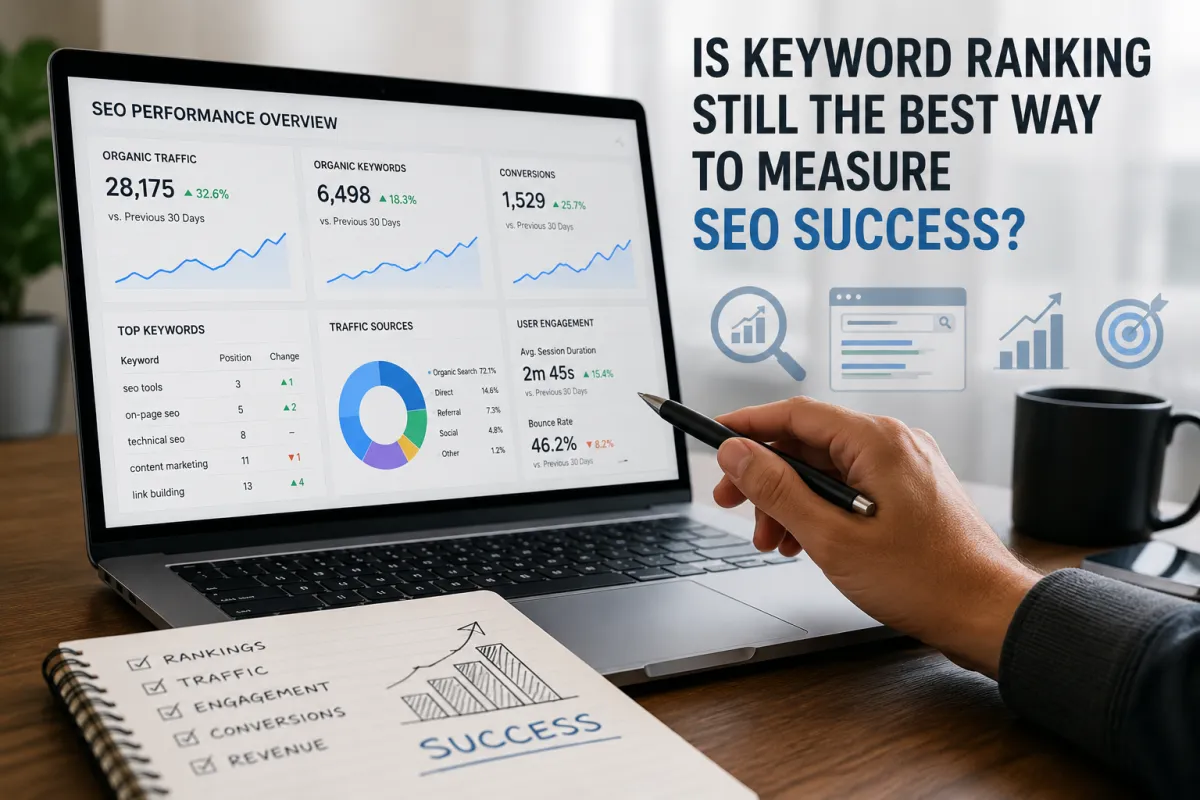
Is Keyword Ranking Still the Best Way to Measure SEO Success?
For many years, keyword rankings were treated as the main scorecard for SEO. If a website moved from page three to page one, the campaign looked successful. If an important keyword reached the top three positions, the work seemed to be paying off.
Rankings still matter. They show whether a website is becoming more visible for searches that relate to the business. But a ranking by itself does not tell you whether that visibility is bringing the right people, generating leads, increasing sales, or helping the business grow.
Search behavior has changed. People use different phrases, ask longer questions, search on different devices, and often visit several sources before making a decision. Google Search Console now gives businesses access to metrics such as clicks, impressions, click through rate, and average position, which gives a much broader view than a single keyword position.
For a business working with an SEO agency Southwest Ranches FL, this means SEO reporting should look beyond rankings and connect search performance with actual business results.
Why Keyword Rankings Still Matter
Keyword rankings are not useless. Far from it.
They can show whether a page is gaining visibility for searches that matter to the business. If a local roofing company moves higher for a service related search, more potential customers may see that company in Google.
Rankings can also help identify problems. If several important pages suddenly drop, an SEO team can investigate whether there was a technical issue, a search algorithm change, stronger competition, or a change in search intent.
The problem starts when rankings become the only number a business watches.
A website can rank number one for a keyword that very few people search. It can also rank well for a phrase that attracts visitors who have no interest in buying the company's product or service.
That is why ranking should be treated as one part of the report, not the entire report.
Does Traffic Tell You More Than Rankings?
Traffic can provide a better picture of what happens after a website gains visibility.
Suppose a page moves from position twelve to position five. That sounds good. But what happens next?
Did organic clicks increase?
Did visitors stay on the website?
Did they contact the business?
Did they request a quote?
Did they make a purchase?
These questions connect SEO work to business results.
Google Search Console tracks clicks and impressions, while analytics platforms can help businesses study what visitors do after reaching the website. Google explains that Search Console performance data can be reviewed by queries, pages, countries, devices, and other dimensions.
A strong SEO report should connect these numbers instead of showing ranking changes without context.
Why Impressions Are Worth Watching
Impressions tell you how often a website appeared in Google Search results.
A rise in impressions can show that the website is becoming visible for more searches. This can happen even when average rankings do not change much.
For example, a business may rank around position eight for several important phrases but begin appearing for dozens of related searches. Its average position may remain similar, yet its overall search exposure can increase.
That is still useful progress.
Impressions become more meaningful when you compare them with clicks and click through rate. A website that receives more impressions but no increase in clicks may have a problem with search intent, titles, snippets, or the type of searches it is appearing for.
What Does Click Through Rate Tell You?
Click through rate, or CTR, shows the percentage of impressions that resulted in clicks.
It helps answer a simple question: When people see your listing, do they choose it?
A page can rank well and still receive fewer clicks than expected. The title may not match what the searcher wants. The description may be weak. Competing results may look more useful.
Improving CTR can sometimes bring more traffic without moving the page to a higher position.
This is one reason ranking alone does not tell the full story.
Are Leads More Important Than Traffic?
For most businesses, yes, A local company does not usually want website traffic just for the sake of having more visitors. It wants people who may become customers.
A service business might track phone calls, contact forms, quote requests, appointment bookings, or consultation requests. An ecommerce company may track purchases and revenue.
These actions show whether SEO is contributing to the business.
For example, imagine an online store gains 30 percent more organic traffic but sales remain unchanged. That should lead to another question: Are the new visitors looking for products the company sells, or are they arriving for informational searches?
The answer can change the entire SEO plan.
Can Revenue Be Used to Measure SEO?
Yes, when the business can connect organic traffic with sales data.
Revenue is often a more useful business metric than ranking position because it shows financial impact.
A local service company might track how many qualified leads came from organic search and how many became paying customers. An ecommerce business can track organic purchases and revenue.
Not every SEO result appears immediately in revenue. SEO can take time, especially when a new website or page is competing against established websites. Google notes that changes can take anywhere from hours to several months to show their effects in Search, so businesses should give campaigns enough time before making decisions based on short term movement.
What About Organic Conversions?
Conversions are another useful way to judge SEO performance.
A conversion can be different for every business. It could be a completed purchase, a phone call, a form submission, an email signup, or a booked appointment.
The important point is to define the action before measuring it.
If a company says SEO generated 5,000 visitors, that sounds impressive. If only three visitors became customers, the number needs more context.
A smaller website with 1,000 visitors and 40 qualified leads may be producing better business results.
Should Businesses Track Search Intent?
Yes, Search intent helps explain what people actually want when they type a query into Google.
Someone searching for “how much does a new roof cost” may still be researching. Someone searching for “roof replacement company near me” may be closer to contacting a contractor.
Both searches can bring valuable traffic, but they serve different purposes.
A good SEO service should account for these differences when creating pages and choosing keywords. A page should match the reason behind the search rather than forcing one keyword into every paragraph.
Google's own SEO guidance recommends creating useful, well organized content that helps people find information and make decisions.
How Does Local SEO Change the Measurement Process?
Local businesses need to look at more than standard keyword positions.
A company may rank well for a broad service phrase but receive most of its customers from nearby searches. Local visibility can involve map results, business listings, branded searches, reviews, website visits, phone calls, and direction requests.
For a business serving Coral Springs, for example, ranking for a service phrase without a location may not tell the whole story.
A better report could show whether the company is becoming more visible for local searches and whether that visibility is producing calls and leads.
What Should an SEO Report Include?
A useful monthly report should make the numbers easy to understand.
At minimum, businesses should review:
Organic clicks
Organic impressions
Click through rate
Average search position
Organic sessions
Qualified leads
Conversions
Revenue when available
Top performing pages
Important search queries
These numbers should be compared with an earlier period so the business can see what changed.
Google Search Console provides the core search performance metrics of clicks, impressions, CTR, and average position.
The report should then connect those search numbers with website and business data.
What If Rankings Improve but Leads Do Not?
This is a common situation.
It does not always mean the SEO campaign failed.
The website may be ranking for the wrong keywords. The pages may attract people who are still researching. The contact process may be difficult. The service pages may not answer customer concerns. Pricing information may be unclear.
The next step is to find where people stop moving forward.
A good SEO team should investigate the entire path from search result to website visit to conversion.
How Can Paid Advertising Support SEO?
SEO and paid advertising can work together.
Organic search may take time to build. Paid advertising can help a business reach customers while its organic presence grows.
A company may use SEO to build long term visibility while working with a google ads agency in Southwest Ranches, FL to target searches that have strong buying intent.
The two channels can also provide useful data for each other. Paid search can reveal which phrases produce clicks and conversions, while SEO can build content around topics that customers repeatedly search for.
What Metrics Should Small Businesses Focus On?
Small businesses do not need a huge spreadsheet filled with dozens of numbers.
Start with the metrics that connect directly to business goals.
If the goal is lead generation, track organic traffic, qualified leads, phone calls, form submissions, and conversion rate.
If the goal is ecommerce growth, track organic sessions, product page visits, purchases, revenue, and conversion rate.
If the goal is local visibility, track local search visibility, calls, website visits, direction requests, reviews, and local leads.
The right metrics depend on what the business is trying to achieve.
How Often Should SEO Success Be Measured?
SEO performance can be reviewed every month, but decisions should not always be made from one month's data.
Search traffic can change because of seasonality, promotions, holidays, competition, website changes, and search behavior.
Looking at three month, six month, or year over year trends can provide more useful information.
Google recommends giving SEO changes time to show their effect and reviewing performance after a reasonable period rather than expecting every change to produce an immediate result.
Is Keyword Ranking Still Important in 2026?
Yes, but it should not stand alone.
Ranking data can show whether a website is gaining visibility. Traffic can show whether people are visiting. CTR can show whether searchers are choosing the result. Conversions can show whether visitors are taking action. Revenue can show the financial outcome.
Together, these numbers tell a much clearer story.
The best SEO reports do not hide ranking data. They put it in the right place.
Conclusion
Is keyword ranking still the best way to measure SEO success? No, ranking is useful, but it is only one part of the picture. A business needs to know whether its search visibility is bringing the right visitors, generating leads, producing sales, and contributing to revenue. Tracking rankings alongside clicks, traffic, conversions, and other business results gives owners a clearer view of what their SEO investment is actually doing.
If you want to build a stronger search strategy, Strategic Web Designs provides professional digital marketing services designed to help businesses improve their online visibility and reach more potential customers. A focused SEO service can help your business track meaningful results instead of relying on ranking positions alone.
Frequently Asked Questions
Is keyword ranking still useful for SEO?
Yes. Keyword rankings help show how visible a website is for important searches. They are useful when reviewed alongside traffic, clicks, conversions, and other business results.
What is more important than keyword ranking?
For many businesses, qualified traffic, leads, sales, and revenue are more meaningful because they show whether SEO is helping the company grow.
How often should keyword rankings be checked?
Rankings can be monitored regularly, but monthly and longer term comparisons usually provide more useful information than reacting to every daily change.
Can a website succeed without ranking number one?
Yes. A website can generate strong traffic and leads from many searches without holding the first position for every keyword.
What should an SEO agency report each month?
A useful report can include clicks, impressions, CTR, average position, organic traffic, conversions, leads, top pages, and important search queries. The exact metrics should match the company's goals.
