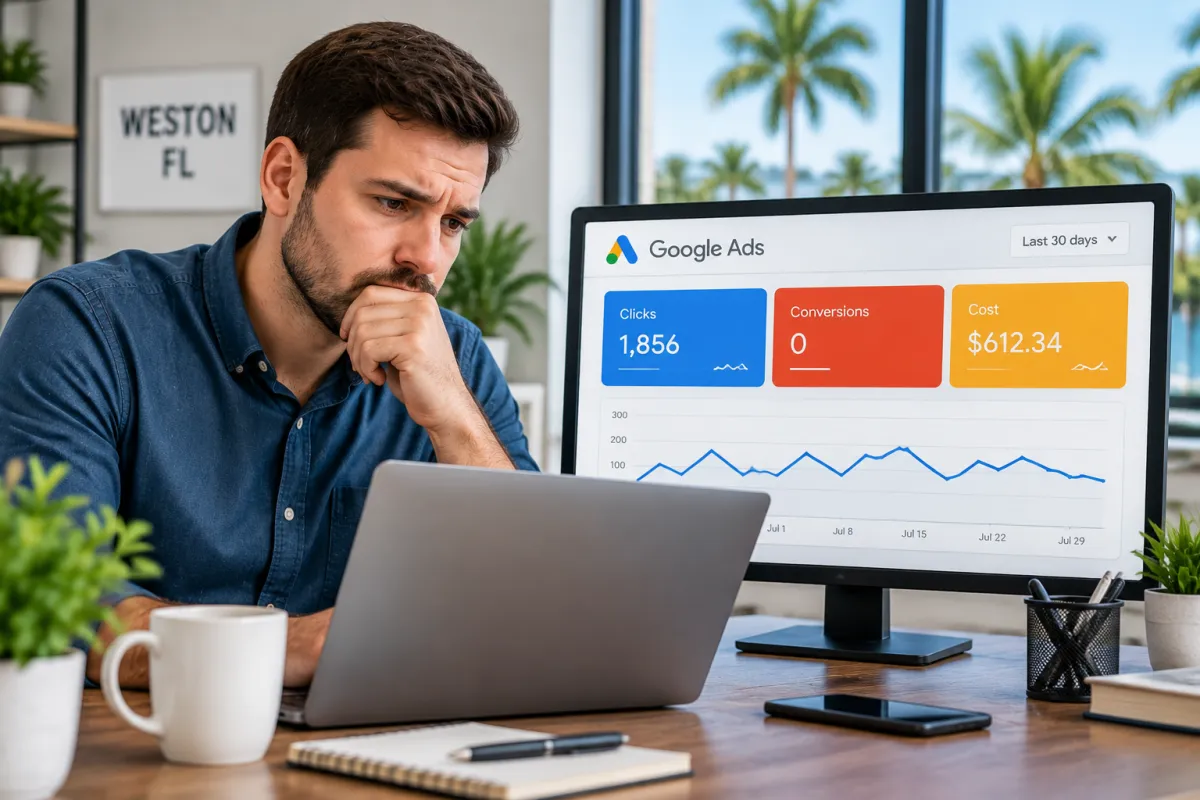
Why Are My Google Ads Getting Clicks but No Leads in Weston, FL?
Getting clicks on your Google Ads may look like a good result at first. People are seeing your advertisements, choosing to click them, and visiting your website. But if those visitors are not calling, filling out forms, booking appointments, or making purchases, something is not working as it should.
This can be frustrating for a local business in Weston, FL. You are paying for every click, so you naturally expect that traffic to bring new customers. When the phone stays quiet and your contact forms remain empty, it is easy to think that Google Ads is the problem.
In many cases, though, the issue is not the advertising platform itself. The problem can be found somewhere between the search a person makes and the action they are expected to take after reaching your website.
Your keywords may be too broad. Your ad may not match the search. Your landing page may not answer the visitor's questions. Your contact form may be difficult to complete. Your location targeting may also be reaching people who are unlikely to become customers.
If you are considering a google ads agency Weston FL, understanding these problems can help you see where your advertising budget may be going.
Clicks Do Not Always Mean Customers
A click only means that someone selected your advertisement. It does not mean that the person was ready to buy from you.
People click ads for many different reasons. Some are comparing prices. Some are researching a service. Others may be looking for information or checking different companies before making a decision.
That is why clicks should never be the only number you use to judge your campaign.
Google recommends looking at conversion data along with clicks and other campaign information to understand which ads and keywords are creating useful customer actions.
For example, imagine one campaign gets 500 clicks but no phone calls or forms. Another campaign gets 100 clicks and produces 15 leads. The second campaign may be much more useful to your business even though it received fewer visitors.
The real question is not simply, “How many people clicked?”
The better question is, “How many of those people became potential customers?”
Your Keywords May Be Too Broad
Your keywords are one of the first areas worth checking when Google Ads brings traffic but not leads.
Broad keywords can attract people who are not actually looking to hire your business. This can happen when the keyword is related to your industry but does not show strong buying intent.
For example, imagine that you provide home remodeling services. If you target a general term such as “home improvement,” you could receive clicks from people looking for ideas, products, videos, tutorials, or general information.
You still pay for those clicks even though those visitors may have no plans to hire a contractor.
Take some time to review the actual searches that triggered your ads. Look for searches that are closely related to your service and location. You should also look for searches that clearly show someone wants to hire a business.
Negative keywords can help prevent your ads from appearing for searches that are not relevant to your business.
Your Ad May Not Match the Search
Your advertisement creates an expectation before the visitor reaches your website.
If someone searches for a specific service and sees an ad that talks directly about that service, they are more likely to expect the next page to provide the same information.
Problems start when the ad and landing page do not match. For example, suppose your ad says, “Same Day AC Repair in Weston.” A person clicks because they need AC repair. Instead of reaching an AC repair page, they land on a general homepage that talks about several unrelated services.
Now the visitor has to search through the website to find the information they wanted.
Many people will simply leave. Google recommends keeping your ads, keywords, and landing pages closely connected so visitors can quickly find what they expected after clicking.
Your Landing Page May Be Losing Leads
Your landing page has a big job. The advertisement gets the visitor to your website, but the landing page needs to give that visitor a reason to stay and take action.
A good landing page should quickly explain what you offer, where you provide it, why customers should consider your business, and what they should do next.
If the page contains too much information, confusing navigation, weak messaging, or no clear way to contact you, visitors may leave without becoming leads.
Google also notes that landing page experience includes factors such as usefulness, relevance, ease of navigation, and whether the page meets the expectations created by the advertisement.
For a local business, the page should make the next step simple. If you want phone calls, your phone number should be easy to find. If you want quote requests, the form should be visible without forcing people to search for it.
Your Call to Action May Be Weak
Visitors should not have to guess what you want them to do. A landing page that ends with a vague phrase such as “Learn More” may not give a ready customer enough direction.
Your call to action should match the service and the visitor's reason for clicking.
For example, a local business could use phrases such as “Request an Estimate,” “Schedule an Appointment,” “Call for a Quote,” or “Book a Consultation.”
Google recommends using a clear call to action that matches the advertisement and landing page.
Make the action easy to complete. If your goal is phone calls, place a clickable phone number in an easy to find location. If your goal is form submissions, keep the form short and simple.
Your Website May Be Hard to Use on Mobile
A large number of people search for local businesses from their phones. This means your Google Ads landing page needs to work well on a small screen.
A page that loads slowly or looks difficult to use can cause visitors to leave before they contact you.
Open your landing page from your own phone and look at it as a new customer would. Check whether the phone number is easy to see and tap. Try filling out the form. Read the page without zooming in.
Also check whether images, buttons, menus, and forms load correctly.
These may sound like small details, but they can affect whether a visitor stays long enough to become a lead.
Your Contact Form Could Be the Problem
Sometimes the advertising campaign is working, but the website is making it difficult for people to contact the business.
Think about your contact form. Does it ask for too much information?
Some forms ask for a name, email address, phone number, company name, address, budget, project details, and several other questions before allowing the visitor to submit the request.
That can feel like too much work.
For many local businesses, a short form is enough to begin a conversation. You can collect additional information during the phone call or follow up later.
You should also test the form yourself.
Submit a test request from a phone and from a computer. Check whether the message reaches the correct email address. Make sure someone is actually notified when a new lead arrives.
A broken form can make a successful advertising campaign look like a failure.
Your Phone Calls May Not Be Tracked
If your business depends on phone calls, call tracking deserves attention. A person may click your Google ad and call your business, but that call may not appear as a conversion if your tracking is not set up correctly.
Google Ads supports conversion tracking for valuable actions such as phone calls and website interactions.
This means your advertising account may show fewer conversions than your business is actually receiving.
Check how your phone calls are being tracked. Make a test call if needed and confirm that the action is being recorded correctly.
Without proper tracking, you may make campaign decisions based on incomplete information.
Your Conversion Tracking May Be Broken
Conversion tracking is another area that should be checked before you decide that your ads are not working.
Suppose a customer fills out your form and reaches a thank you page. If the conversion tag is missing or installed incorrectly, Google Ads may record the click but fail to record the lead.
Google explains that conversion tracking connects interactions with ads to valuable actions such as sales, sign ups, and phone calls.
Google also explains that its conversion tracking system uses tags and click information to connect website actions with ad interactions.
So if your account shows zero conversions, do not immediately assume that nobody contacted you.
First, make sure your tracking works. Test your contact forms. Test phone number clicks. Test appointment requests. If you sell products online, test the purchase process as well.
Your Ads May Be Showing in the Wrong Areas
Local businesses need to pay close attention to location targeting. If you serve customers in Weston and nearby areas, you may not want your advertising budget going toward people who live far outside your normal service area.
Review the locations where your advertisements are appearing and compare them with the areas your business actually serves.
This can be especially important for businesses such as dentists, contractors, home service companies, lawyers, medical practices, and other businesses that depend on local customers.
Getting a click from someone who cannot realistically become a customer does not help your bottom line.
Your Ad May Attract the Wrong People
A high click rate can sometimes be misleading. An advertisement may attract many people because it uses a broad offer or interesting headline. However, those people may not be ready to buy.
The goal of your campaign should not be to get as many clicks as possible.
The goal should be to get useful clicks from people who are likely to become customers.
Your ad should clearly explain what you offer and who you serve. If someone is only looking for free information, they may decide not to click.
That is not necessarily a bad result. It is better to have fewer clicks from people who are genuinely interested than a large number of clicks from people who will never contact your business.
Your Offer May Not Stand Out
Sometimes people click your advertisement, visit the website, and then choose another company.
Why? They may not see a clear reason to contact you.
Price is one factor, but it is not the only thing customers consider. People may also look at reviews, experience, availability, warranties, financing, response time, service areas, and reputation.
Suppose a competitor offers a free consultation and your landing page does not explain what happens when someone contacts you.
The competitor may have an easier path to the sale. Your page should explain what customers can expect. Give them useful reasons to choose your business without making claims you cannot support.
Check Search Terms Before Increasing Your Budget
When a campaign receives clicks but very few leads, increasing the budget is usually not the first step.
More traffic will not fix a problem with your landing page, keywords, tracking, or offer.
Start by reviewing the search terms. Then look at the advertisement and compare it with the landing page. After that, test your contact forms, phone tracking, location settings, and conversion tracking.
A simple review process can help you find the problem:
Review the search terms that triggered your ads.
Remove searches that have little connection to your service.
Check whether the keywords show buying intent.
Compare your ad message with the landing page.
Test the website from a mobile phone.
Test every contact form.
Test phone tracking.
Check your conversion tracking setup.
Review your location targeting.
Compare recorded leads with actual sales and inquiries.
This gives you a much clearer picture of campaign performance.
What Should a Google Ads Review Include?
A proper google ads Service review should look at the entire customer journey rather than focusing only on clicks.
Start with the campaign setup. Make sure your campaigns are organized around useful services, products, or business goals.
Then review the keywords. Are they closely related to things customers can actually buy from your business?
Next, review the search terms. This can show whether unrelated searches are using your budget.
After that, look at your ad copy. Does the advertisement clearly explain the service? Does it match the search?
The landing page should receive the same attention. The visitor should find the information promised in the ad without having to search through several pages.
Finally, check conversion tracking. Google recommends conversion measurement because it helps advertisers understand which ads and keywords lead to valuable customer activity.
When Should You Work With an Agency?
Running Google Ads while managing a business can be difficult. A small or medium sized business owner may already be handling customers, employees, sales, scheduling, and daily operations. Finding time to review search terms, landing pages, tracking tags, and campaign performance can be difficult.
This is where an experienced google ads agency Weston FL can help.
The right agency should not only talk about getting more clicks. It should look at whether those clicks are creating calls, forms, appointments, sales, and other actions that matter to your company.
An SEO agency Weston FL can also help when paid advertising and organic search need to support each other. Google Ads can bring paid traffic to your website, while SEO can help your pages appear in unpaid search results.
The two strategies have different purposes, but they can support the same business goals.
A Simple Way to Find the Problem
If your Google Ads are getting clicks but not leads, do not make several changes at the same time.
Start with the search terms.
Then review your ads.
Next, check the landing page.
After that, test the forms and phone numbers.
Finally, check your conversion tracking.
This step by step approach makes it easier to see what changed and whether your next adjustment actually helped.
It also keeps you from wasting money by increasing your advertising budget before fixing the problem.
Conclusion
Are your Google Ads getting plenty of clicks but still leaving your sales pipeline empty? Before deciding that Google Ads is not working, look at what happens after each click. Your keywords, advertisements, landing pages, website experience, contact forms, phone tracking, location targeting, and conversion setup can all affect your results. For businesses that need help with their online marketing, Strategic Web Designs provides digital marketing services to help companies improve their online presence and reach more qualified customers. A focused google ads agency Weston FL strategy can help connect your advertising budget with the calls, inquiries, appointments, and sales that matter to your business.
Frequently Asked Questions
Why are my Google Ads getting clicks but no leads?
There can be several reasons. Your keywords may be too broad, your ads may attract the wrong audience, your landing page may be weak, your contact form may be difficult to use, or your conversion tracking may not be working properly.
Is a high click through rate always a good thing?
Not necessarily. A high click through rate only tells you that people are clicking your ads. It does not tell you whether those visitors are becoming customers. Conversion data provides a better view of whether the campaign is producing useful actions.
Should I stop my Google Ads campaign?
Not before checking why the campaign is failing to produce leads. The problem could be related to keywords, landing pages, tracking, location targeting, or your offer. Fixing the actual problem may be better than stopping the campaign completely.
How important is the landing page?
The landing page is very important because it is where the visitor decides whether to contact your business. Google recommends making landing pages relevant to the advertisement and keywords and making sure visitors can easily find what they expected.
How can I check if my conversion tracking works?
Test the actions you want customers to take. Submit your contact form, click the phone number, and test appointment requests. Then check whether those actions appear correctly in your Google Ads conversion data. Google provides tools and tags for measuring these actions.
Should I focus on clicks or conversions?
If your goal is lead generation, conversions are generally more useful than clicks because they show whether visitors are taking actions that matter to your business. Google recommends using conversion information to understand which campaigns, ads, and keywords are producing valuable customer activity.
Can SEO help if Google Ads are not producing leads?
Yes. SEO can help your website gain unpaid search visibility for relevant services and local searches. It can also support the same pages that you use in your paid campaigns. Paid search and SEO can work together when both have clear goals.
